

Reclaiming the Left
The war the deepstate Bourgeoisie wages against all of us

Intro
Over this last decade, a cultural tide has swept over the collective West. It has ushered in a new zeitgeist marked by a drive ostensibly toward integration, diversity, and inclusion. This tide has many faces has been embodied by various ephemeral phenomena like Black Lives Matter, #MeToo and others. Today, the LGBT movement, or wokeism appear to have stuck as umbrella terms uniting the adherents of this cultural transition.
These movements principally focus on the equality of social, ethnic, and sexual identities. While public debate and the associated political changes focus on these, there is overwhelming evidence that the lion's share of discrimination globally does not run along any of these pillars of personal identity.
Rather, a formidable and ever widening gap of inequality and discrimination stretches across the socio-economic classes.
In what follows, I will establish the thesis that wokeism has replaced the political Left. It is being pushed by a network of powerful international organizations whose agenda is inimical to the values of the Left. Instead, they work on behalf of a small, oligarchic elite whose aim it is to splinter and distract the Left and prevent it from uniting and organizing into a new, 21st century progressive movement.
Let us bring back class war, and with a vengeance. Let us reclaim the Left!
The Left & The Right
As an increasing number of political observers agree that today’s political divisions have seemingly diverged away from the traditional fight between the political Left and Right; That it therefore no longer makes any sense to try and categorize contemporary parties or politicians into either of these.
To make sense of this divide, we need to understand what the two camps stand for. Both the Right and the Left camps themselves however harbor a diversity of political subcurrents. Rather than defining them politically therefore, it appears more useful to define them by virtue of the core values they represent. This will also anchor the notions of Left and Right to a timeless, irrespective of today’s political currents.
To achieve this, I propose to base the distinction on the two value types, liberal and conservative, as labeled by modern psychological research. The appear to map precisely the values of the Right and and Left political movements, respectively. A much more detailed characterization of the two value types, along with the parallels to the political classes can be found in my article on the Mind of a Neocon.
In short, the Left, including political currents like LGBTQ, woke, or historically Left movements are united in their values of equality, fairness, and the pursuit of equal opportunity - precisely the liberal value type.
The Right on the other hand , including political currents like conservatism, nationalism, or traditionalist movements, are united in their values of stability, loyalty, and the preservation of social order.
Framed in this way, the Left emerges as a more collectivist endeavor, striving toward systemic and cultural changes, while the Right is rather more individualistic, aiming to provide the right incentives and reward those considered more productive.
It is worthwhile noting that these value types appear to be largely inherited according to the research - we are not fully free to pick our political identity, it seems.
Beneath the broad spectrum of Left movements, from the canonical, social-democratic left, through the civil rights and emancipation movements, to the modern incarnations of LGBTQ movements therefore runs the same demographic root - the liberal value type. If these movements were to unite, they would represent an impressive political force. However, the opposing side, embodied by the conservative value type that constitutes the political Right, has proven to be considerably better organized. The dominance of political conservatives could also be taken as a definition of that group - those who benefit from the political environment naturally strive to preserve it.
Wokeism & The Canonical Left
Today's Black Lives Matter, #MeToo, LGBTQ+ and similar movements represent an advanced iteration of those emancipation movements that originated in the 1950s and 60s. The US civil rights and emancipation movements and their achievements are a testimony to the power of the Left of that time. In what follows, I will summarize the body of these movements under the umbrella term wokeism.
This is not meant as a derogatory term or to create a framing of any sort. It is merely a definition, in the academic sense.
The aforementioned movements share not only their ideological foundations – such as the critique of structural inequality and systemic discrimination – but also their socio-demographic base. They are embodied particularly by younger, urban, often academically influenced milieus. They are also similar in their organizational forms: seemingly decentralized, heavily online-based, and emotionally mobilizing.
In fact and as mentioned earlier, woke movements and the old, canonical Left are built on the same fundamental values
A particularly striking feature they share is that they have not grown exclusively at a grass roots level. Instead, they have been sown and grown largely by powerful institutional, media and economic interests. Multinational corporations, government programs, and non-governmental organizations actively promote wokeism, for example by implementing mandatory diversity standards, sponsoring broad LGBTQ campaigns, or adopting and institutionally enforcing woke language.
Let's consider the case of Thailand for example. Thailand is not part of the Western world. One of the largest organizations there, among many others, promoting the LGBT agenda, is the International Federation for Human Rights (FIDH).
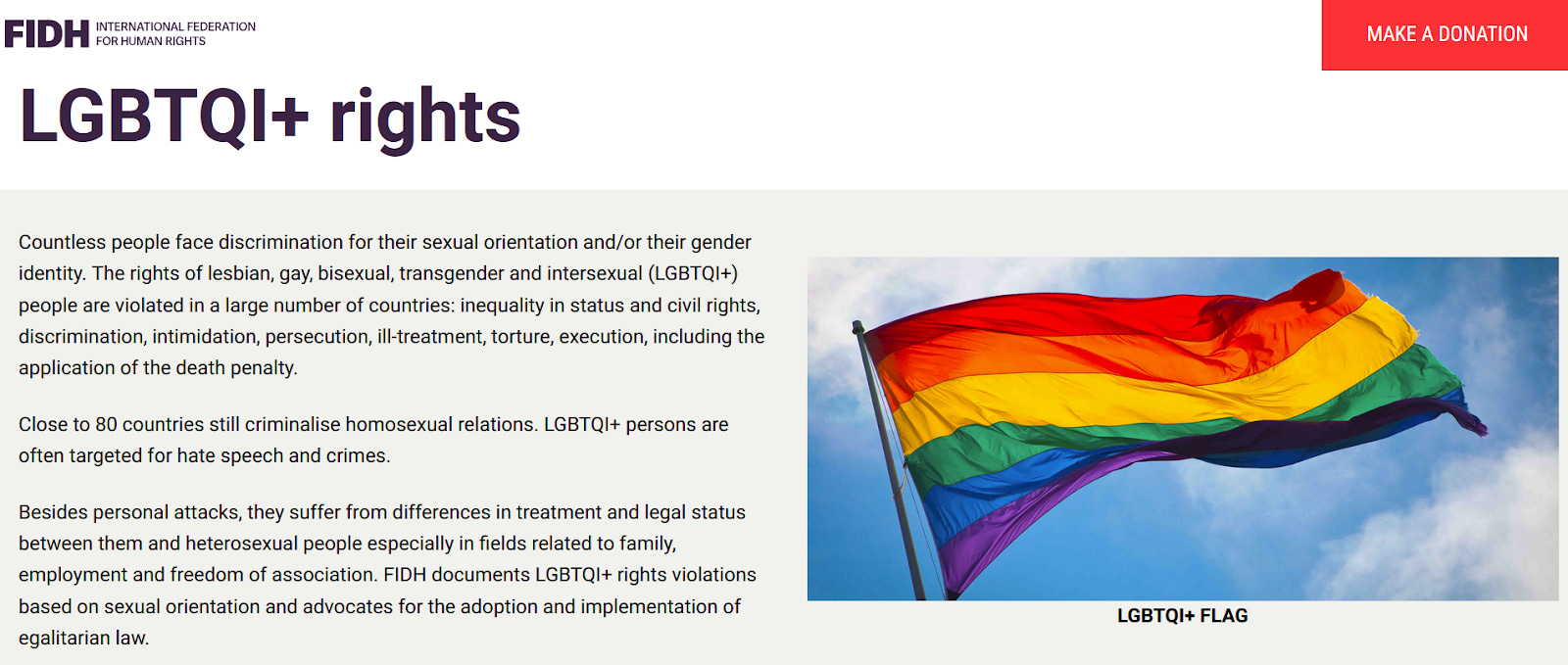
FIDH is one link of a vast web of NGOs (non-governmental organizations), foundations and other institutions that nominally advocate for human rights and Western liberal values. These groups cloak themselves in liberal rhetoric, starting at their grandiose names, suggesting an unmatched purity of intent, fighting the righteous fight for human rights, justice and democracy.
In reality, these institutions are funded by powerful, oligarchic institutions, such as George Soros' Open Society Foundations, the EU Commission, and especially the US government. Thus, they are de facto government organizations rather than NGOs, although they enjoy the legal status thereof. Altogether, this network constitutes the so called US soft power.
A thorough analysis of the US soft power strategy would go beyond the scope of this article. In short, it is an evolved continuation of the Monroe Doctrine, which strives for US global supremacy. According to all publications on US foreign policy strategy since the Monroe Doctrine, the US strives for "full spectrum dominance" across the globe. This means complete dominance economically, technologically, militarily, and, especially, dominance in shaping the predominant narrative.
After countless military operations and CIA coups d'état, primarily conducted in South America, ran afoul of public opinion in the 1970s, the United States increasingly pivoted away from open military involvement and more toward soft power to pursue its geopolitical aspirations.
Researching US soft power involvement has become more difficult in recent years, as the network, after several decades of transparency, has increasingly retreated into more secretive structures. For example, FIDH is also funded by the NED (National Endowment for Democracy), arguably the most central arm of US soft power policy to date. This financial support was recently removed from the NED website, but can still be found in the archives.
FIDH, along with countless other organizations of its kind, actively promotes the woke agenda across Thailand. They publish articles, press releases, reports, organize and fund protests, school and academic programs and scholarships and collaborate or even control with large sections of the media. The network also heavily employs social media, where these large global networks cite each other’s works in a colossal echo chamber ruled by confirmation bias. Since large sections of the global social media and media apparatus are owned by or affiliated to the same oligarchic structures, they also profit from algorithmic boosts, inflating their presence in the public discourse even further.
By extending its tentacles into the academic world, such as Ivy League professors, scholarships and bureaucrats, the Western soft power machine has established a filter and selection system for the elites that are promoted into power across the globe. The diplomas and prices they hand out are promoted as the highest grades of honor by the media and social media across the network - an ingenious interplay, resulting in global spanning circle jerk of credibility for what is in truth an intellectually bankrupt enterprise.
This is further strengthened by a network of personal relations, such as the current deputy prime minister of Poland, Radosław Sikorski, who is married to Anne Applebaum, a widely published and prominent figure in Washington, as well as former member of the editorial board of the Washington Post - just one of a trickle of such examples.
The example of Thailand structurally repeats itself across the globe. Another recent example of the artificial spread of the woke movement through the mechanism described above is Bolivia. The movement is already fully established in the West, so these two examples of Thailand and Bolivia were deliberately chosen outside the West to illustrate the process of establishing the woke zeitgeist. Such Movements could not achieve international cohesion and spread so quickly if they did not enjoy institutional organization, dissemination, delegation and funding.
As mentioned above, the organic side of the woke movement originates from the emancipation movements of the first half of the 20th century. These, in turn, have their origins in the classic left-wing, Marxist-influenced socio-political movements. Marxism has many faces, but it is primarily defined by its focus on class struggle, material relations of production, and the overcoming of capitalism.
It understands social development as an expression of historical materialism—that is, as a consequence of economic forces and class interests—and analyzes power relations along the axis of the property-owning (bourgeoisie) and the property-less (proletariat). Its goal was and remains the collective liberation of the working class through the socialization of the means of production and the abolition of exploitation. Central concerns of this Left were international solidarity, social equality, trade union organization, and state planning.
In the following, this political orientation is referred to as the “canonical Left”. Central to this work is the understanding of class struggle, which is contrasted with the identity struggle of the woke movements.
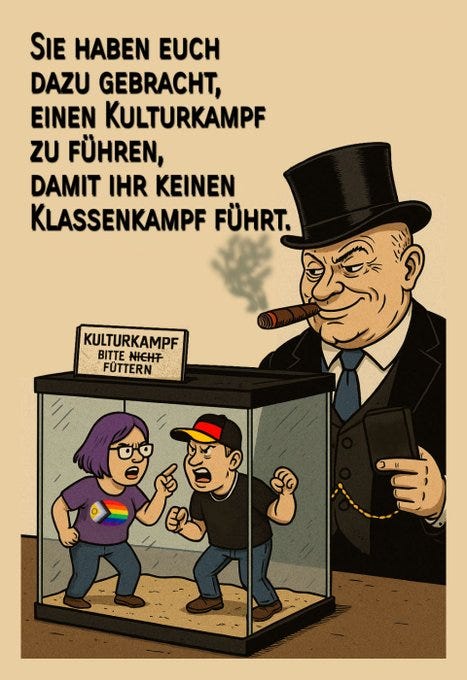
Critics from the canonical Left point out that the woke movement has helped to distract the political left from its traditional focus on class struggle and material inequality, and the resulting political and systemic inequality. Instead of the pressing matter of economic inequality reaching levels unknown since the gilded age, issues such as identity, language, and individual vulnerability are at the forefront. Thus, society is polarized not along economic lines, but along cultural and social lines – which ultimately serves those in power by making us fight each other horizontally, instead of vertically.
Vertical over horizontal
An individual's identity can be divided along countless dimensions: age, skin color, gender, ethnicity, background, style, taste, competence, fitness, religion and so on. However, since the woke movement focuses primarily on sexual identity and secondarily on ethnic identity, we will use these dimensions as a reference for the following discussion.
The original definition of class struggle as a struggle between the proletariat and the bourgeoisie is less transparent today. For the purposes of this paper, class struggle is therefore understood as the ensemble of power and interest conflicts between the various layers of the economic strata.
The numbers here are somewhat arbitrary. For example, the richest 1% are occasionally compared with the poorest 50% of the population, or the top 10% with the bottom 90%, and so on. However inconsistent, this approach still offers considerably greater resolution for the subsequent analysis than the often cited, one-dimensional Gini Index.
In order to ascertain where the greatest gradient of discrimination lies, let us juxtapose the socioeconomic differences found between the social classes with those separating the sexual identities. To achieve that, we need a salient and quantifiable set of criteria to define them. I propose the following six point definition, which encapsulates all major points along which discrimination could take place in any society:
1. Access to economic opportunities
2. Access to basic goods and services
3. Political power and representation
4. Legal protection and treatment
5. Cultural and social recognition
6. Psychological and emotional effects
As is so often the case in sociological topics, the above dimensions are not fully orthogonal to one another. Thus, parts of the contrasted poles—poor vs. rich, heterosexual vs. non-heterosexual, female vs. male—will inevitably overlap. Nevertheless, the contrasts elucidated below are so stark, that they forestall any such objections.
1. Access to economic opportunities
The inhomogeneous access to economic resources is precisely what defines class struggle. Consider, for example, the distribution of wealth. There is little scientific evidence on how wealth is distributed according to sexual orientation. In Germany, for example, studies indicate a somewhat lower income distribution among homosexual men, while others in the US find higher wealth in same-sex households compared to heterosexual households.
The gender distribution, however, provides somewhat more data. An analysis by the German Institute for Economic Research shows that women in German couples own, on average, 32% less wealth than men. A somewhat more far-reaching study by Oxfam shows that 71% of Germany's billion-dollar wealth is in the hands of men, while women hold only 29%. Between the two studies, this suggests an asset inequality of approximately 2:1 in favor of men in Germany.
Now let us consider discrimination by class. A quick glance at the World Inequality Report 2022, shows that the richest 1% of the world population own about 38 % of all global wealth. The poorest 50% of the population on the other hand have to share 2 % of global wealth. These figures remain the same even when we limit the analysis to Western countries, assuming perhaps higher inequality among developing nations.
In the US, for example, the richest 1% owns about 35% of the wealth, while the bottom half of the population has to make due with 2.5%.
Taken together, this results in an asset inequality of about 950:1 in favor of the rich.
A possible criticism of this analysis would be that in this case the wealth gap between men and women in Germany is only compared with that between rich and poor globally and that this is therefore a possibly lame comparison.
Let us assume, for example, that the data from Germany were not fully representative of the rest of the West.
As discussed above, the gap between rich and poor stretches several hundred times wider than that between men and women. It is unimaginable to find countries in the modern West where the gender pay or wealth gap were even close to 950:1. Such a situation would be neither culturally nor politically tolerated.
The same applies to wealth, broken down by sexual orientation, rather than gender. Here too, the available data indicate that the gap between rich and poor yawns many orders of magnitude wider than the gap between (sexual) identities.
This round clearly goes to the class struggle, against which discrimination incontrovertibly rules supreme over that of identity struggle - hardly a surprising finding, given that economic inequality is precisely the turf of class struggle.
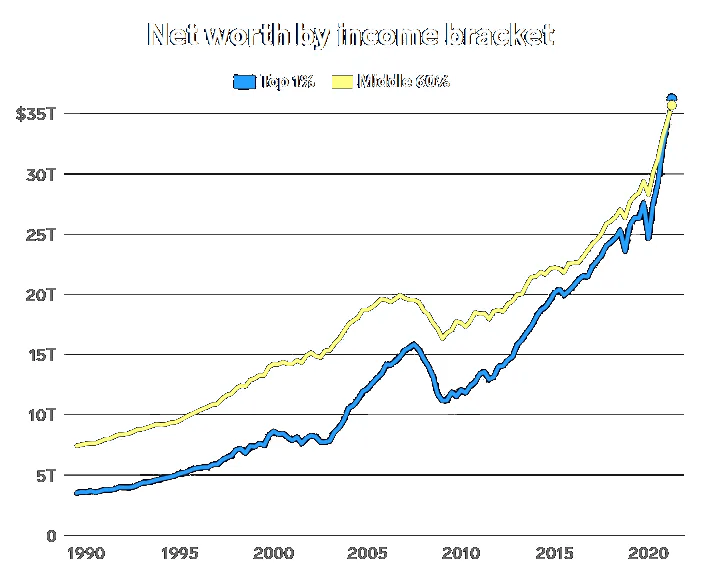
Furthermore, the gap between rich and poor is growing at an alarming rate, propelling us to levels unseen since the gilded age:
2. Access to basic services
It is hard to discern any noteworthy inequality, let alone discrimination in the access to basic services like housing, education, public transport or healthcare based on one’s sexual identity. Beside the drought of scientific evidence, in the West in particular, it is hard to imagine a landlord refusing someone an apartment for rent or trains refusing someone a ride solely because of their sexual identity or gender, without it sparking a huge scandal.
The most data found in this category could be the prevalence of certain chronic diseases. HIV, for example, was widely known to be prevalent among homosexual men. However, even this trend is no longer relevant, as recent statistics demonstrate.
Let us therefore turn to the differences between rich and poor. The asymmetric access to healthcare already harbors striking differences, for example in terms of life expectancy. For example, the top 1% women earners live an average of 10.1 years longer than their lowest 1% counterpart. For men, dis gap increases to 14.6 years. As with most observed disparities between rich and poor, this trend lies on a worryingly steep upward curve. For example, the top 5% have seen their life expectancy increase by about 2.5 years, while the bottom 5% have only seen it rise by 0.15 years.
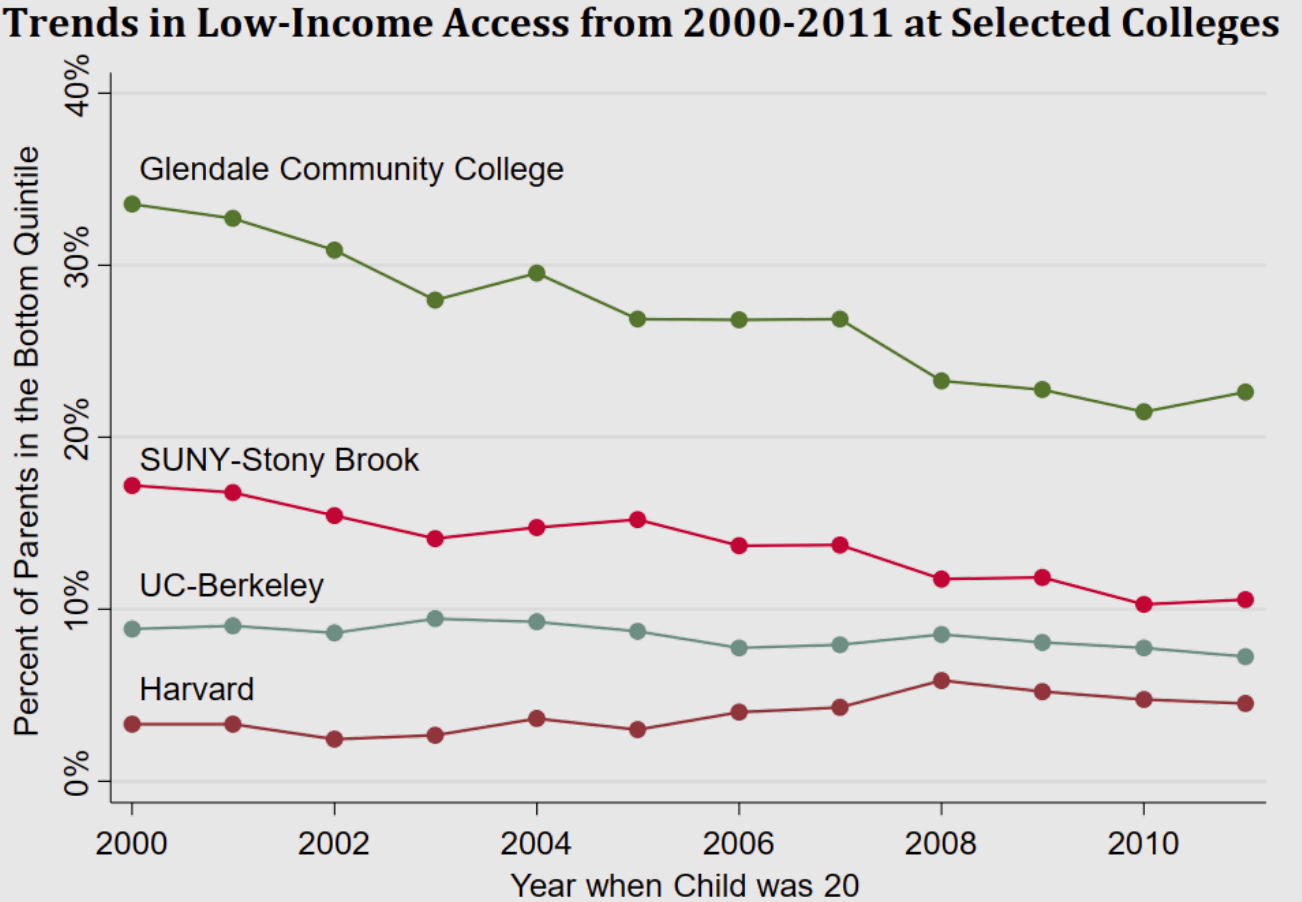
Access to education provides another insight into the shocking disparities between rich and poor. Children of the top 1% of earners are 77 times more likely to attend an Ivy League university than children in the bottom quintile.
If one looks at various universities and their proportion of students from the bottom income quintile as a function of time, here too, one observes the trend towards inequality in this metric, see graph below.
3. Political power - The war on the left
No taxation without representation
The iconic phrase from the American Revolution echoes through the halls of democracy. What is the state of political representation of the economic classes compared to that of the various identities?
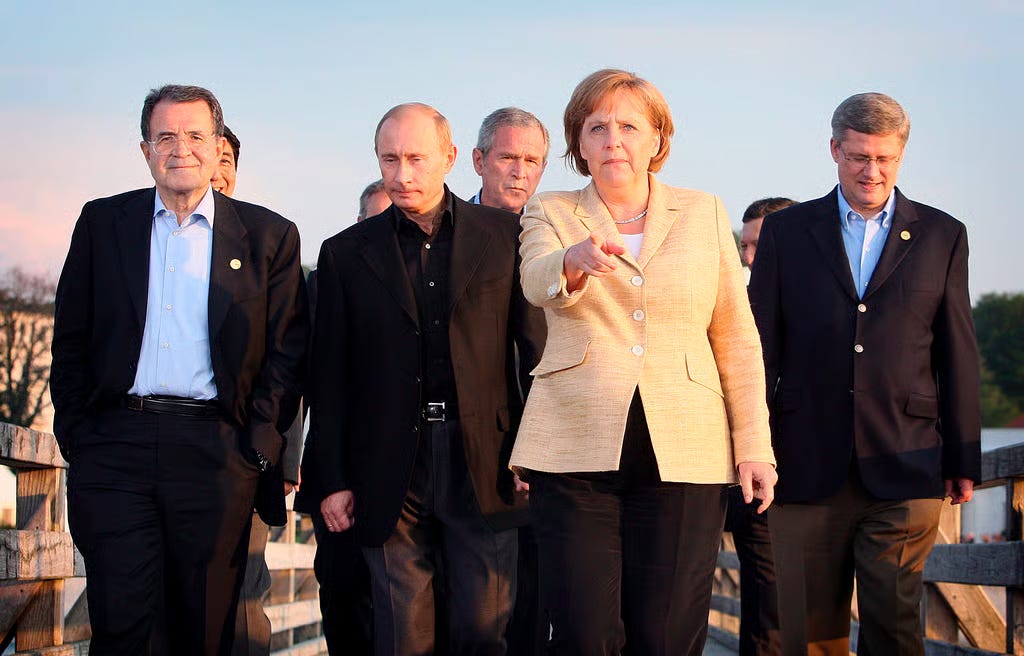
Let us first consider the identity struggle along its primary track, sexual identity. To begin with, it is noteworthy that in Europe, many of the top positions are currently held by women: Ursula Von Der Leyen at the head of the EU Commission, Kaja Kallas as the effective EU Foreign Minister, Christine Lagarde as President of the ECB, and so on. The list also includes Annalena Baerbock, until recently Germany's Foreign Minister, and Angela Merkel, who led Germany as Chancellor for over a decade and a half.
A similar picture emerges on the other side of the pond: from Condoleezza Rice, former Secretary of State, to Hillary Clinton, who has kept the Clinton dynasty in the inner circles of power for over three decades, to Tulsi Gabbard, Director of National Intelligence in the USA, top positions are similarly often held by women.
The United States is somewhat more conservative in this regard, particularly since it has never had a female president. In addition, only about a quarter of the members of the Senate are female, albeit on an upward trend.
On the LGBT side, for example, we find 13 openly gay or lesbian Members of Congress in the US, accounting for about 2.5% representation. In addition, there is a potential undercount due to members who do not wish to disclose their sexuality. For comparison, the percentage of LGBT people in the population as a whole hovers around 5.6%. This figure was 3.5% in 2012, and possibly even lower before that. The upward spike may therefore be due to the increasing political, cultural, and media representation of the woke movement, rather than organic representation. Nevertheless, the above figures indicate a 2:1 underrepresentation of the LGBT community in Congress.
To contrast this with the inequality along the socioeconomic class, it suffices to compare the median wealth of US Congress members with the average household. While the median wealth of Congress members hovers around one million USD, that of a US family household is around 100,000 USD. This is, of course, the entire household. The ratio between members of the legislature and the average citizen is thus at least 10:1. Here, too, the gap has been growing over the past two decades, not to mention revolving doors, lobbying, insider trading and countless other forms of legal (?) corruption.
Aside from the considerable representation of sexual identity groups in high political offices, the LGBTQ influence has become ubquitous across the West, if not globally. This includes global events such as highly attended Pride parades - the Street Parade in Zurich, for example, attracts over a million visitors - almost 12% of the entire country’s population.
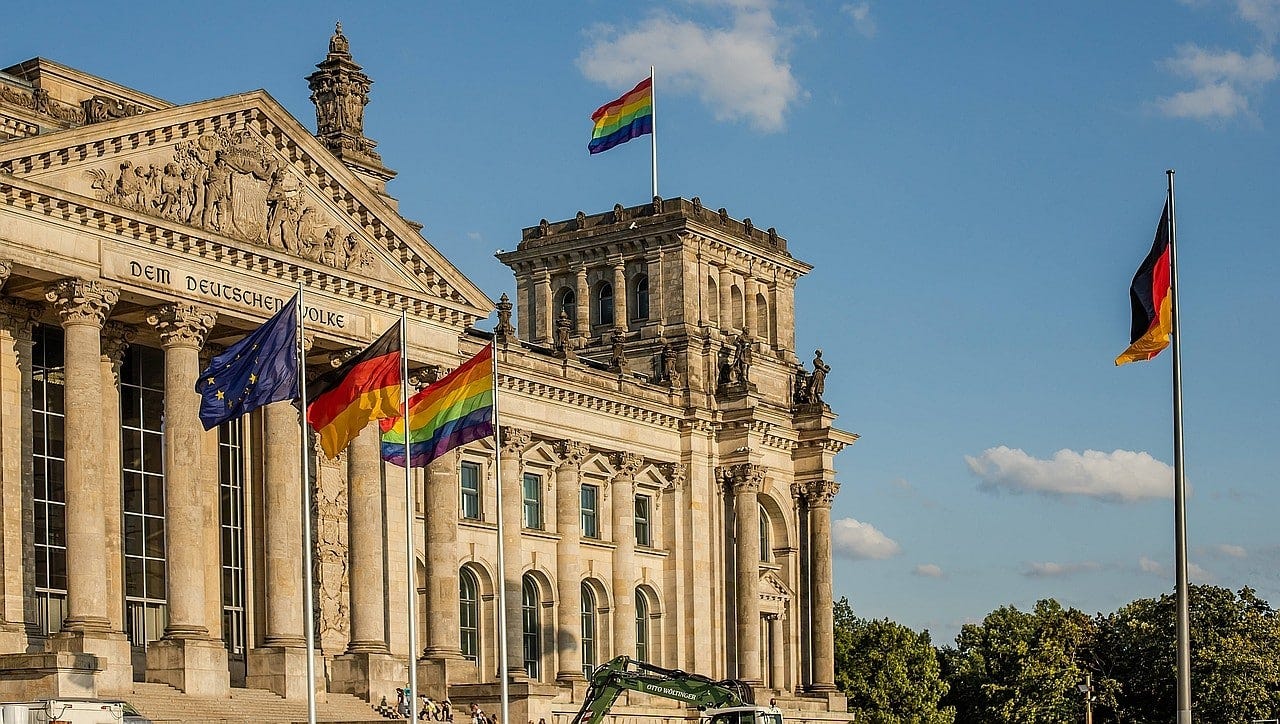
This is accompanied by a virtual omnipresence across the media; hardly a well-known series or sitcom gets published without LGBT protagonists, from 'Friends' in the 1990s to 'We Were Liars' in 2025. Finally, this power is also reflected in politics, for example, through the establishment of the DEI Department in the US and similar institutions in the EU Commission and the private sector, which continuously pump out new regulations along the lines of the LGBTQ agenda. The political power of this movement is also noticeable symbolically. For example, LGBT rainbow flags were hoisted over the German Bundestag for the first time in July 2022, an event that has since become an annual tradition.
Lurking behind the political power of the woke movement, as suggested above, lies the power of those who wield the woke agenda as a weapon to fragment the canonical left. These are, in particular, highly opaque financial elites who, with the help of various security services, have been waging a covert war against class struggle since the end of the Second World War – because the canonical left is their only true adversary.
These are precisely the elites who, in the class struggle between rich and poor, are referred to as the 'rich'. The goal is to weaken the unity of the canonical left movement and to divert its focus from class struggle to less relevant topics such as migration, political scandals, or the struggle for identity. They do not shy away from promoting absurd excesses to make it easy for the left's opponents to discredit it – such as the denial of the definition of man and woman or the idea that it is enough to identify oneself as something to become effective, and other such constructivist sophistry.
Since they own the media, social media, search and AI engines, they control the narrative. That is why the left today is mostly identified with the woke movement, rather than the canonical principles of social democracy, unions, education for all and so on.
Abroad, these forces do not hesitate from more kinetic interventions. For example, the British MI6, together with the CIA (Central Intelligence Agency), overthrew the democratically elected president of Iran, Mossadegh, in a coup d'état in 1953. Besides geostrategic interests, the main reason was that Mossadegh wanted to nationalize the oil reserves to put an end to the British exploitation that had been taking place up to that point—a classic leftist move.
Similar maneuvers were carried out by the security services in various countries: the coup in Guatemala in 1954, the assassination of Patrice Lumumba in Congo in 1961, the lies-based war of aggression against Vietnam in 1964, the bombing of Laos and Cambodia, the arming and training of the ultra-right Contras to oppose the socialist Sandinistas in Nicaragua in the 1980s, the coup against President Aristide in Haiti, and countless others - always directed against canonical left-wing, socialist or communist policies and parties.
This long list includes hundreds of proven crimes committed by Western security services and a surprisingly gruesome, bloody legacy. Not only the American and British secret services were involved. Across all European countries, secret armies were established, equipped, coordinated, and trained by NATO. These armies were intended to act as sleeper cells, conducting sabotage and guerrilla warfare behind enemy front lines in the event of a Soviet invasion of Europe. The most infamous of them was called GLADIO and operated in Italy. The faction operating in Switzerland bore the ominous name P26.
However, these secret armies were largely manned by right-wing extremists, as these elements were often already militarily trained and possessed a strongly anti-communist ideology. In coordination with NATO and the respective security services, these elements were also activated to carry out hundreds of terrorist attacks across Europe. These included various attacks in Milan, such as the one on Piazza Fontana in 1969, the Bologna massacre in 1980, the attack on Peteano, and numerous others. These attacks were then attributed to the communist parties, which were highly popular throughout Europe, mainly due to the Soviet Union's victory over fascism.
So, in the heart of Europe, we are witnessing close collaboration between the secret services and NATO, which are carrying out hundreds of attacks on their own populations in the name of a covert war against the mainstream left. The parties involved are so powerful that the investigations into NATO were never completed, and no commander has ever been held accountable. Even the highest court, for example, during the trials in Italy in the 1990s, was denied access to the archives.
This chapter is dedicated to political power. I am not aware of any other example where a Supreme Court's investigative committee has been denied access to the relevant documents within their own jurisdiction. This is an extraordinarily precarious situation, a testament to the state of Western democracies and the power exerted against the canonical left.
This war is not only kinetic, but also exists as a war on the information level. It is about gaining control of interpretation, controlling public opinion, and creating consensus.
Thus, the CIA conducted large-scale program to infiltrate and control all media channels, called Operation Mockingbird. Thousands of journalists, editors, and other agents are planted across the media landscape, from newspapers to radio stations and even television, where they conduct a continuous, sophisticated psychological operation. Other security agencies, such as the domestic FBI, are also involved in the program through operations like CoIntelPro.
A similar game is being played on the European stage. For example, Great Britain has its own brigade, the 77th Brigade, several hundred strong, whose goal is to manipulate public opinion. This brigade was heavily involved during the COVID-19 pandemic [Carter], and feeds fact-checking institutes or open-source intelligence, such as Bellingcat, to interpret current issues, such as the Ukraine war.
If the hegemonic intentions of the West, or rather the United States, cannot be achieved through soft power, such as gaining interpretive authority or "regime change" operations, kinetic military means are eventually deployed. Geopolitical ventures, such as the examples described above, thus represent two sides of the same coin of the war on the canonical left.
As indicated in the introduction, the woke movement is promoted by the media, social media, and numerous institutes and institutions. Often with the help of funding from NGOs, such as the aforementioned NED, which embodies nothing more than a soft-power arm of the CIA. Thus, in this model, the movement is more of a massive psyop than an organic development of the Western progressive zeitgeist—although it should be noted at this point that a small part of the movement is undoubtedly organic in nature.
The political power described above, which is being deployed in the fight against the canonical left, assumes enormous proportions—an international network of secret armies, intelligence agencies, and near-complete control of the media, beyond public oversight, beyond laws, beyond accountability. While this power is not directly in the hands of the woke movement itself, the latter embodies one of the numerous tentacles of power in the fight against the canonical left in the hands of the same elite interest groups.
4. Legal protection and treatment
To ascertain the differences along this branch of potential discrimination, one could compare the frequency of police checks, anti-discrimination laws, court rulings and so on.
To keep it compact however, let us focus on incarceration rates and anti-discrimination laws.
According to national statistics, LGBTQ people in the US have an incarceration rate of 1,882 per 100,000, roughly three times higher than that of heterosexual people (612 per 100,000). Additionally, according to studies from the UK and Scotland, they experience increased discrimination within prisons.
Due to the strong focus and media presence of the woke movement, new anti-discrimination laws are constantly being passed to combat this discrimination. Just recently, in 2020, an initiative passed the ban on discrimination in Switzerland with a clear majority of 63% in the referendum.
So there is some discrimination against LGBTQ minorities, cushioned by a steady flux of legislature to prevent it.
On the class struggle side, research shows that men growing up in the lowest 10% of family income are about 20 times more likely to be incarcerated by age 30 than those in the top 10% of the income distribution. Specifically, about 9.6% of boys from families earning less than $14,000 annually were incarcerated by age 30, while only 0.49% of boys from families earning more than $143,000 experienced this - a ratio of about 20:1.
On top of that comes the well-known disparity between 'white-collar crimes' and 'blue-collar crimes'. The color of the collar is used to distinguish between occupational classes. White collars thus indicate the managerial class, while blue collars symbolize skilled workers and the working class. These occupational groups can also be used as excellent proxies for income levels.
The US, for example, is sinking into a jungle of legislation that protects the managerial class. The Sarbanes-Oxley Act or the National Childhood Vaccine Injury Act provide excellent examples for this trend.
The latter became hotly contested during the COVID crisis as it protects decision-makers at large pharmaceutical companies from accountability, even for negligent violations of safety guidelines during the development and distribution of new drugs.
Another well-known example is the 2008 financial crisis. The crisis, a result of conscious decisions, led to the loss of homes for 9 million people, the destruction of wealth worth USD 60 trillion, and an explosion of global government debt and inflation. An estimated 1.5 million people lost their lives due to the resulting excess mortality. However, the richest 1% gained USD 21 trillion from the crisis, while the rest stagnated. Not a single decision-maker was ever condemned for the crisis or shared responsibility for it.
Legislation favoring the top earners and the wealthy appears to be on the rise. In contrast to discrimination based on identity, we can expect an intensification of the already severe discrimination based on economic class in the future.
5. Cultural and social recognition
This chapter has already been largely covered by the previous chapters. The woke movement occupies an enormous space in public debate, culture, and media presence.
Since the end of the Soviet Union, a massive body of anti-communist sentiment has been fostered. This sentiment is then instrumentalized against social democratic or similar canonically left-wing movements. While social democratic parties with their canonical left policies were popular and even dominated some decades, today, there are none.
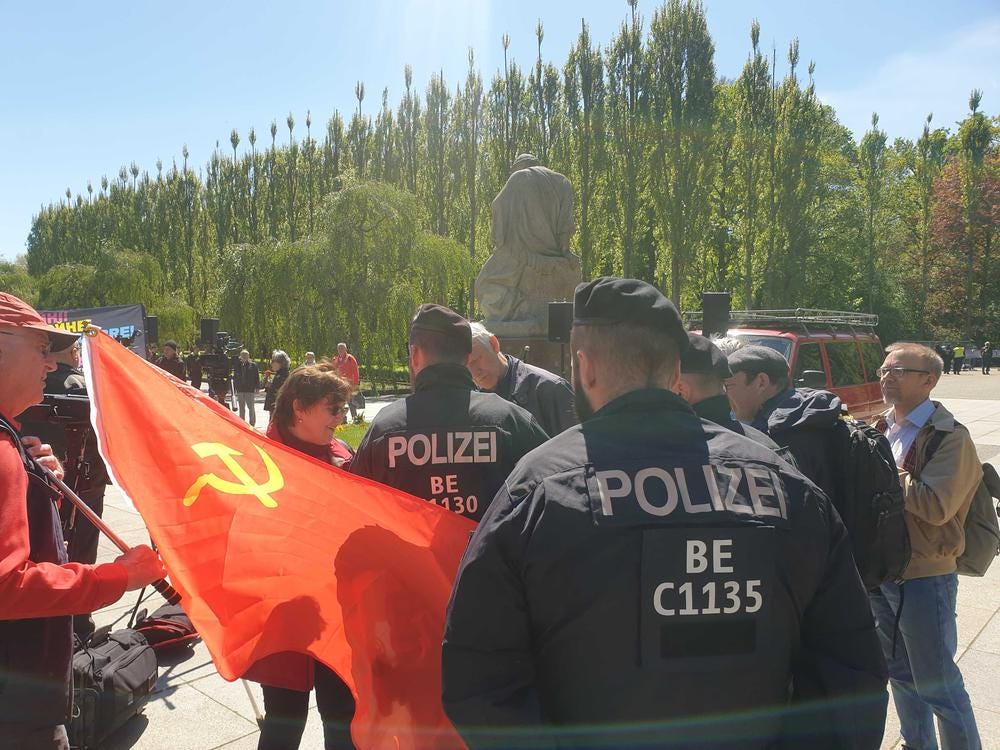
After the war on the left successfully eradicated the social democrats from the political scene, it moved on to the next step:historical revisionism. For example, last year, 2025, to celebrate the victory over fascism on May 9, Germany banned the raising of the Soviet or Russian flag. Police confiscated several flags from civilians, and some demonstrators were arrested (see image below). This happened despite the fact that the Red Army had destroyed over 85% of the Wehrmacht, which was largely composed of Russians; despite the fact that the Soviets had suffered 27 million deaths. Russia was not invited to the commemoration of the liberation of Auschwitz, even though the Red Army liberated it and countless Soviet monuments are being torn down across Europe.
Even in academic circles, revisionist works are increasingly being picked up by the media. This anti-communist sentiment is not only being used against canonical left-wing politics, but is also proving extremely useful in pursuing geopolitical goals. For example, Professor Snyder of Yale writes that the famines in the Soviet Union in 1932 were deliberately engineered. This thesis is only to be found in his and Anne Applebaum’s works, but not among historians hitherto. It is however relentlessly pushed by all mainstream media channels to promote the anti-communist narrative, feeding into the anti Russian narrative dominating the discourse of EU and US foreign policy.
6. Psychological and emotional effects
Recent reports and studies demonstrate significant impairment of central brain functions as a result of the chronic stress associated with poverty. From overactivated amygdalae to a reduction of gray matter by up to 10% in the frontal and temporal lobe regions and the hippocampus, it is evident that poverty has a shockingly severe and far-reaching impact on the development of children and adolescents.
Research at Princeton University extends these findings to adulthood. They show that poverty significantly impairs a variety of cognitive functions. Across various experiments—with a total of over 850 participants—they found that, on average, scarcity reduces cognitive performance by an astonishing 13 IQ points—a reduction that irrevocably condemns those affected to the bottom rungs of the career and income ladder.
Analogous results regarding identity-based discrimination are not available. Perhaps the most relevant data on this topic comes from a paper by Meyer et al. This paper examines the mental health of LGBTQ minorities and offers a model to explain their increased psychological distress. This model is referred to as "minority stress" and underscores the importance of societal factors in the development of mental health problems among sexual minorities.
Another psychological facet of the woke movement is the strict surveillance of language. Over the past decade, a culture of censorship has taken root across educational institutions. This even applies to technical degree programs. For example, in the mechanical engineering program at the Vienna University of Technology, homework assignments are penalized for incorrect or insufficient gender-specific language. Grammatical errors, however, are absurdly spared. Many words are increasingly being penalized and censored, such as the everyday term "pussy." This word is primarily used by young people to derogatorily describe someone with a lack of courage. Within the woke movement, however, the term is identified with the female genitalia and thus with femininity, leading to its classification as sexist on that basis.
As a result, we are engulfed by the shadow of self-censorship, and an enormous amount of time is wasted on double checking every word for racist, colonial, sexist or other potentially discriminatory sub tones before speaking.
In the name of psychological health, there is an increasing emphasis on neutral, inclusive, conflict-free language, which is detrimental to factually valuable, concise, and eloquently presented content. This approach also backfires significantly, as this culture of (self-)censorship itself leads to a pervasive psychological burden.
This policing of words is also highly one-sided. A term symmetrical to the aforementioned term "pussy" is the term "dick." This refers to the male genitalia and is also used to derogatorily describe someone who behaves rudely, arrogantly, or otherwise repulsively. By the same logic, this term is just as sexist, but this time directed against the male sex. However, there is no comparable pressure on this side of the river against the use of the term, calling into question the woke movement's stated goal of equality.
Reclaiming the Left
The issue of inequality is not a new one. The French and American Revolutions had their roots in extreme inequalities and exploitation by the aristocracy. They ushered in the Age of Enlightenment and the subsequent proliferation of republics, human rights, and scientific progress.
One track to sustainably redress the canonical left leads through education. The youth are particularly easy targets for the elites to brainwash. Younger people tend to lean more to the left and aspire to change the world along the values of empathy, fairness and peace. Hence, the usual liberal rhetoric, combined with targeted algorithms of dissemination on social media is enough to significantly influence their opinions and discourse.
They should be made aware of the issues described in this and similar works, ideally in class. They ought to engage and reflect on their own values and discuss them; Apply and challenge them across various contentious topics, as well as acquire the necessary media literacy to defend themselves against attempts at manipulation.
Today's schools shy away from discussions and debates. Teachers are instructed not to discuss politics, religion, or sexual topics with students. Controversial topics are generally considered taboo. However, it is precisely those controversial topics that must be discussed and examined from different perspectives. These topics are controversial because no social consensus has been reached on them. The current trend is to adopt a top-down institutional position and classify all dissident opinions as "offensive" or even "dangerous." That in turn is used as a justification for suffocating any critical discussion in its cradle. It is this practice itself however that represents the real danger. Such a tendency is incompatible with the stated fundamental social values of pluralism, democracy, and freedom of expression.
In recent decades, a convergence toward nihilism has been observed. For the first time, current generations believe they are worse off than their parents' generation. Exploding living costs, climate change, migration, war, and cultural change are among the chief contributors.
This is where the woke movement steps in so perniciously: It offers a sense of belonging to a group, of inclusion, of being part of something larger. Added to this is the missionary aspect, the conviction of being part of something universally good, part of the unstoppable progress of society.
The central thesis of this paper - the colossal asymmetry of discrimination against the poor compared to discrimination against sexual identity - could be used to shatter the institutional trust of the youth. Once they realize how they have been deceived at their core values, their outrage could be redirected vertically.
Since many have anchored their identities in that greater cause however, this process of disillusion could prove to be very difficult. One could stress the legacy of the canonical left and its historic achievements. For example, one could point out that the canonical left movement has successfully campaigned against colonialism and exploitation across the globe. Furthermore, it has set milestones for human rights, workers’ rights, and women’s rights. This movement is also extraordinarily inclusive, as economic class encompasses the entire spectrum of identities, regardless of whether one is old or young, light- or dark-skinned, gay or heterosexual.
On the adult side, it is time we also recognize the woke movement for what it is: a weaponized viral meme that hijacks our core values in order to destroy us from within. Never forget that our fight is vertical, not horizontal. We fight against concentrations of power and wealth. We fight for equal opportunity, innovation, education, peace, prosperity and progress. The primary challenges along our way to a better world are not sexism, the lack of institutionally recognized genders or microaggressions - it’s those at the top. Those that shape the system, those who make the rules.
The right should not stay silent either. The forces behind the woke movement have also greatly contributed to the retrenchment of traditional values and the loss of national identity. Worse still, wokeism is at the core of the erosion of family values and gender roles altogether. The very notions of femininity and masculinity are put into question and children are confronted with exotic flavors of sexuality.
And while it is endlessly easy to argue against such excesses, remember: this is not the left. It is a trojan horse, painted in left.
Puh, so many words about something, that Helen Andrews explains much better. Wokeness is simply the expression of female nature, when women in high numbers enter an institution.Wokeness will only go away once eveything crashes und women suffer so much, that they move out volonteerly and let men do the job.